If you've never prepared a medical device FDA premarket notification, commonly known as a 510(k) submission, figuring out where to begin can be daunting. The FDA website provides a goldmine of information but extracting those golden nuggets requires lots of digging. In this post, we'll provide a primer on how to approach the FDA 510(k) approval process, explain how the process works, and talk more about predicate device research and identifying the right product code.
Basic Steps in the Medical Device Premarket Notification Process
We'll explain various steps in the process throughout this blog series, but let's start with a holistic review of the FDA approval process.
Confirm classification of your medical device and whether it falls under the 510(k) pathway.
Using the FDA website, identify the appropriate three-letter product code and regulation number for your device.
Conduct research on the FDA database and select a predicate for comparison.
Search on the FDA website for applicable FDA guidance documents.
Determine which international "consensus standards" may apply to your device.
Identify clinical data and/or testing that may be required for your device.
Complete performance testing and perform clinical studies (if required).
Assemble all documentation into the 510(k) application.
Review the Refuse to Accept (RTA) checklist to ensure that you're following the FDA guidelines for completeness.
Pay the 510(k) review fee, get the receipt, and then submit the 510(k) to FDA.
Receive confirmation from FDA within 2 weeks that your 510(k) was accepted for substantive review.
If your 510(k) is determined to be substantially equivalent, you will receive a letter and it will be posted on the FDA website — this serves as proof that your device may be legally marketed in the US. No certificate will be issued.
The official nomenclature for a 510(k) is premarket notification. We should note that FDA does not actually "approve" 510(k) submissions — they "clear" (authorize) a device to be marketed in the US. That's why a 510(k) is called a premarket notification and not premarket approval (PMA), which applies only to Class III devices. The FDA does "approve" Class III medical devices via the PMA process.
Confirm That You Have a Medical Device That's Regulated by FDA and Needs a 510(k)
This may seem obvious, but the very first step is to confirm that your product is a regulated medical device and needs to go through the 510(k) approval process. Some products — i.e., low-risk Class I devices — do need to be registered with FDA but don't need to go through the FDA 510(k) process. Nearly all Class II devices must procure a 510(k). The information below explains how you can find out whether your device is regulated and needs a 510(k).
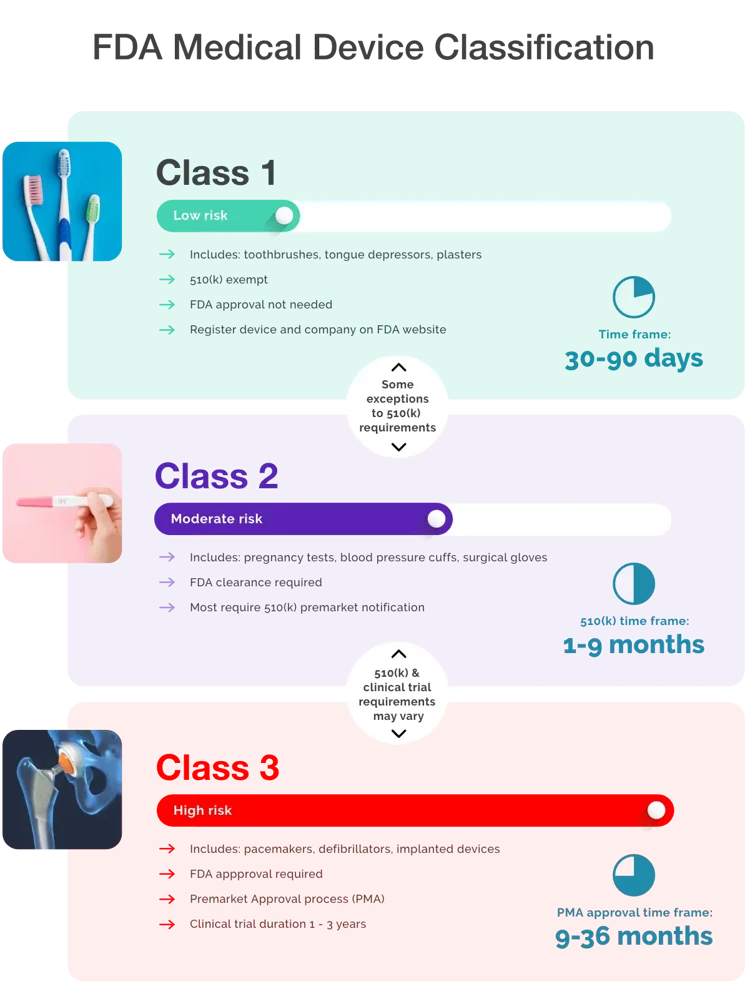
Class I
Low Risk
General controls only. Most are exempt from 510(k). Still require establishment registration and device listing.
Class II
Moderate Risk
General and special controls. Nearly all require a 510(k) premarket notification to demonstrate substantial equivalence.
Class III
High Risk
General controls and premarket approval (PMA). Requires valid scientific evidence including clinical data.
Identify the Right Product Code and Regulation Number for Your Medical Device
FDA uses a predicate-based review approach. This means that when you submit your application to FDA, you will be comparing your medical device to a very similar device that has already been cleared (the predicate) by FDA. This process is quite different from the approach used in Europe or Canada — those markets apply a risk-based rules approach to device registration, which means the device must largely stand on its own merits with regard for safety and performance.
Because FDA requires you to identify a single predicate device, your first step will be to find one. You may already have a good idea of which competitive products would make a suitable predicate for comparison in your 510(k). In any case, you should start your research using the FDA Product Classification database.
Example: Cardiovascular Blood Flowmeter
For example, let's say your company is introducing a new cardiovascular blood flowmeter to the US market. The first step would be to begin with a simple device search on the FDA database. Start with the broadest definition of your product — in this case, just the term "flowmeter."
Search the FDA Product Classification database using the broadest term for your device (e.g., "flowmeter").
Review all returned product codes. In this example, six unique FDA product codes appear for flowmeter-related products.
Click the regulation number associated with the most likely product code (e.g., DPW) and carefully read the full description to confirm it matches your device.
Choosing the Right Predicate Device for Your 510(k) Submission
After you have confirmed the correct product code, go to the FDA's 510(k) database and search for any devices cleared under that product code. This is where things can get tricky and you need to be careful.
In some cases there may be over 100 cleared medical devices under a single classification product code. Here's a key piece of advice: when reviewing your options, sort by the "Decision Date" column and start with devices that were cleared recently. While it may be tempting to choose an older device as your predicate, the FDA frowns upon using devices cleared more than 10 years ago.
Intended Use Must Match
Your chosen predicate must have the same intended use and indications for use as your device. If the indications for use are different, that device will not be a suitable predicate. This is non-negotiable.
Technological Features Should Closely Align
The technological characteristics of your device should closely match the predicate. Significant technological differences can raise additional safety and effectiveness questions that complicate the review.
Read Summaries Carefully
Click the "Summary" link for each candidate predicate and read it carefully. Pay close attention to the intended use, indications for use, testing conducted, and clinical studies performed. Some summaries provide far more detail than others.
Aggregate Your Research
If reviewing a large number of summaries, organize your findings in a spreadsheet. Your chosen predicate does not need to be identical to your device, but it needs to be close enough not to raise additional safety and effectiveness questions.
Seek Expert Advice When in Doubt
Choosing the right predicate is truly critical for the success of your submission. If you have any reservations about your options, seek the advice of an experienced FDA regulatory consultant before proceeding.