See Elevated Oral–Systemic Inflammatory Risk Before the Patient Leaves the Chair
Medora™ is an investigational fingerstick test using proprietary dual-biomarker technology to support rapid oral–systemic inflammatory-risk screening during a dental visit.
Designed to provide a clear binary screening result in under 15 minutes.
From Oral Inflammation to Broader Health Awareness
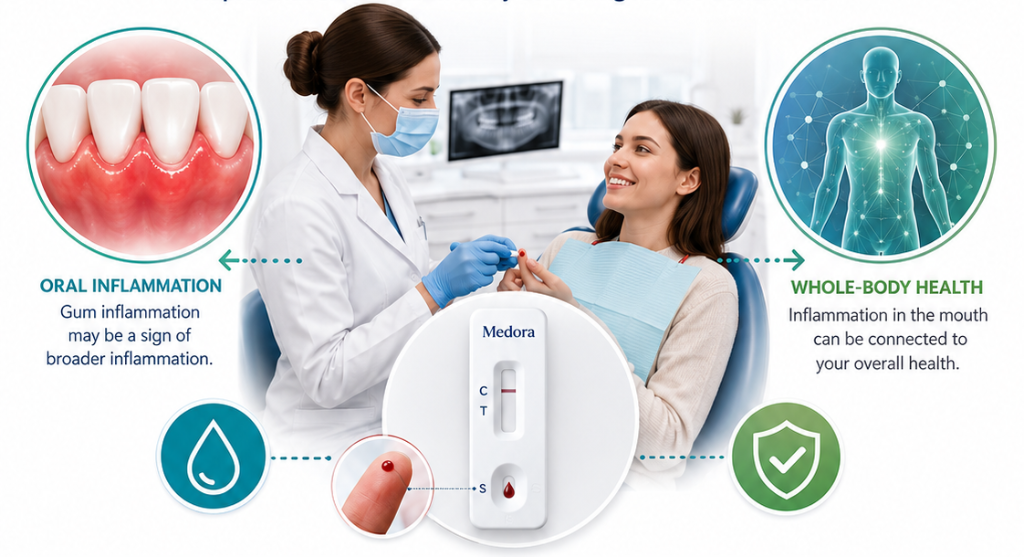
Periodontal inflammation is usually evaluated and treated within the dental setting, but the inflammatory picture may extend beyond the mouth. Medora is designed to bring rapid inflammatory screening into the same dental visit, helping dental professionals recognize when additional health awareness and medical follow-up may be appropriate.
Identify
The patient presents with signs of periodontal inflammation during a routine dental visit.
Screen
A rapid fingerstick-based Medora test provides inflammatory biomarker information during the same visit.
Connect
The result supports broader health awareness and can help determine when appropriate medical follow-up should be considered.
“The goal is not to diagnose systemic disease in the dental office—it is to identify an inflammatory signal that should not be overlooked.”
Medora is an investigational device under development and has not been cleared by the FDA.
Same-Visit Insight
Rapid screening integrated into the existing dental workflow.
Simple & Chairside
Designed as an easy-to-use binary rapid test without complex instrumentation.
Preventive Approach
Helps move care from reacting to disease toward earlier health awareness.
Dental–Medical Connection
Creates a practical bridge between oral-health findings and appropriate medical follow-up.
Transforming the dental visit into a new frontline for preventive health.
Connecting Oral Health with Broader Preventive Care
Periodontal inflammation and systemic inflammatory burden may coexist, but dental professionals currently lack a practical same-visit tool for evaluating this relationship. Medora is being developed to help close that clinical information gap.
A Simple Chairside Workflow
Fingerstick Sample
A small whole-blood sample is collected from the patient during the visit.
Sample Preparation
The blood sample is prepared with the supplied buffer for testing.
Apply to Medora
The prepared sample is added directly to the Medora test cassette.
Plasma Separation & Flow
The integrated test architecture separates plasma and moves the sample across the detection membrane.
Dual-Signal Detection
Two complementary inflammatory signals are evaluated simultaneously within a single test.
Read the Result
Visible test lines provide a simple screening result in approximately 15 minutes—without a separate reader.
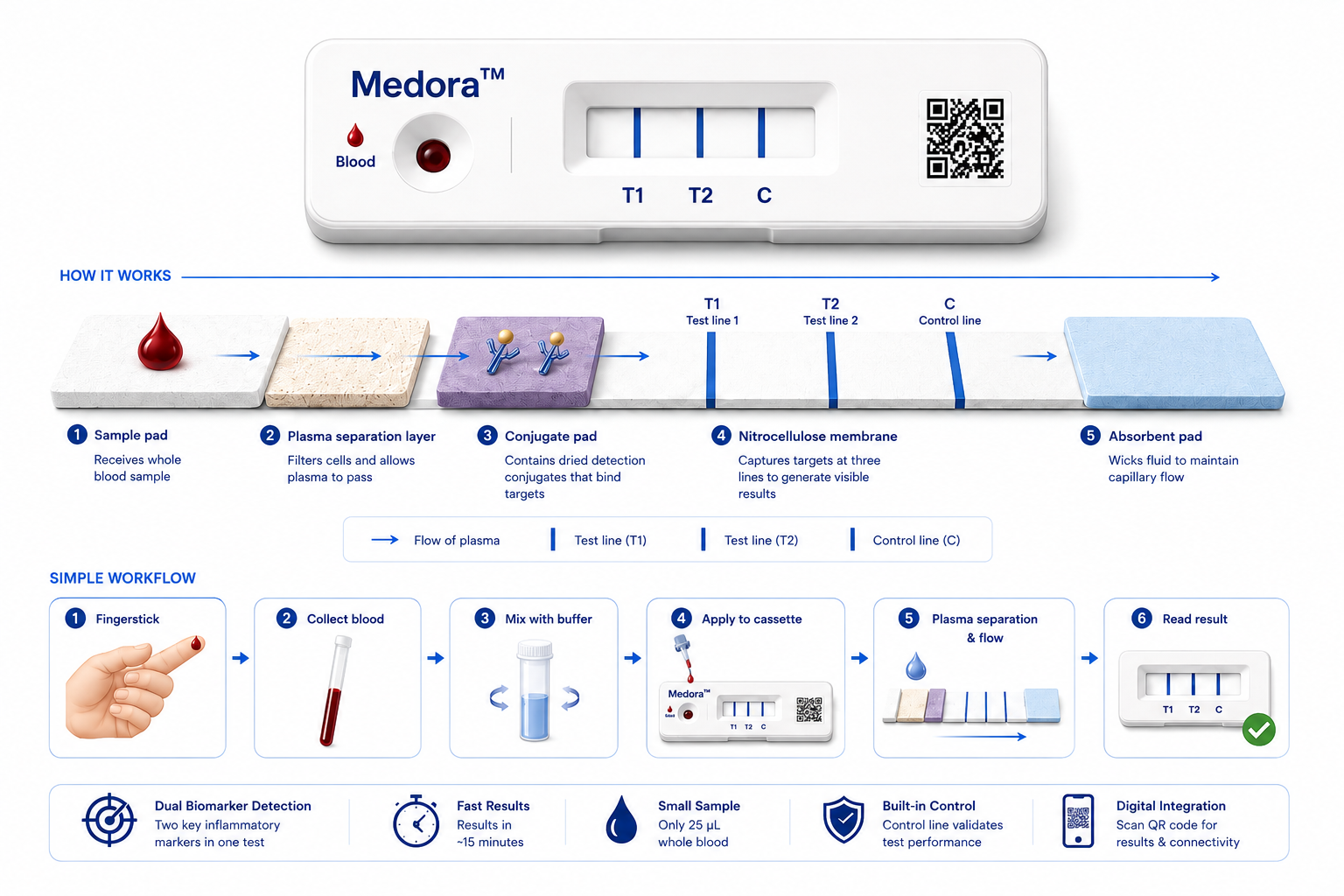
Test lines are unlabeled on the cassette to protect proprietary technology. Medora does not display “IVD” until its regulatory use is confirmed.
A Clear Result, Not a Diagnostic Label
Medora returns a binary inflammatory-risk screening result. It does not produce low, moderate, or elevated categories.
Elevated Inflammatory-Risk Signal Detected
The test detected the predefined proprietary dual-biomarker pattern. The result may support consideration of medical follow-up based on the patient's history and complete clinical assessment.
No Elevated Inflammatory-Risk Signal Detected
The predefined proprietary dual-biomarker pattern was not detected. This does not exclude cardiovascular disease, systemic inflammation, or another medical condition.
Warning: Medora is a screening tool under development. It is not intended to independently diagnose, treat, prevent, or rule out any disease.
How Medora May Fit into Dental Care
Routine dental and periodontal assessment.
Identify a patient who may benefit from additional inflammatory-risk screening.
Perform Medora testing during the same visit.
Review the binary result alongside medical and dental history.
Provide education and consider appropriate follow-up.
Repeat screening when clinically appropriate after the product is authorized for use.
Current research participants do not receive results or treatment recommendations through Medora.
Clinical Value
Medora is designed to add value across the dental–medical care continuum.
Dental Providers
- Adds preventive-health capability to the dental visit.
- Supports patient education.
- Creates a more structured medical-referral conversation.
- Provides an objective screening signal.
Medical Providers
- May provide additional oral-health context.
- Supports communication between dental and medical teams.
- Provides a standardized referral report.
- Does not replace conventional cardiovascular evaluation.
Patients
- Small fingerstick sample.
- Same-visit result.
- Clear and understandable screening output.
- Encourages awareness and appropriate follow-up.
Three Types of Evidence, Clearly Labeled
General oral–systemic research is not direct validation of Medora. We label every source accordingly.
Background Science
Peer-reviewed research describing associations among periodontal inflammation, systemic inflammatory burden, and cardiovascular health.
Background scientific evidencePreliminary Medora Study
A planned observational study to test 120 adults, supporting continued development of the screening methodology.
Product-specific evidenceProspective Product Validation
Planned or ongoing studies evaluating analytical performance, fingerstick-to-reference agreement, workflow feasibility, and clinical decision-support value.
Product-specific evidenceFeatured Peer-Reviewed Publications
Background scientific evidence — these publications describe the oral–systemic research landscape; they are not direct validation of Medora.
Bridging oral and systemic health: exploring pathogenesis, biomarkers, and diagnostic innovations in periodontal disease
Published in Infection — Springer
Periodontal biomarkers in cardiovascular disease: mechanisms, diagnostics, and clinical implications
Published in Infection — Springer
Association between periodontal pathogens and systemic disease
Published in Biomedical Journal
Not every listed publication was produced by Biomedisca. For Medora-specific evidence, see the Science & Evidence page.
Product Development Roadmap
FDA review has not begun.
Prototype development
Analytical verification
Prospective clinical validation
Regulatory submission
Point-of-care authorization
Commercial introduction
Regulatory submission, point-of-care authorization, and commercial introduction depend on prospective study outcomes and applicable regulatory review.
Interested in Evaluating Medora?
We welcome clinical research collaborations, strategic partnerships, and investor inquiries.